
Project Overview
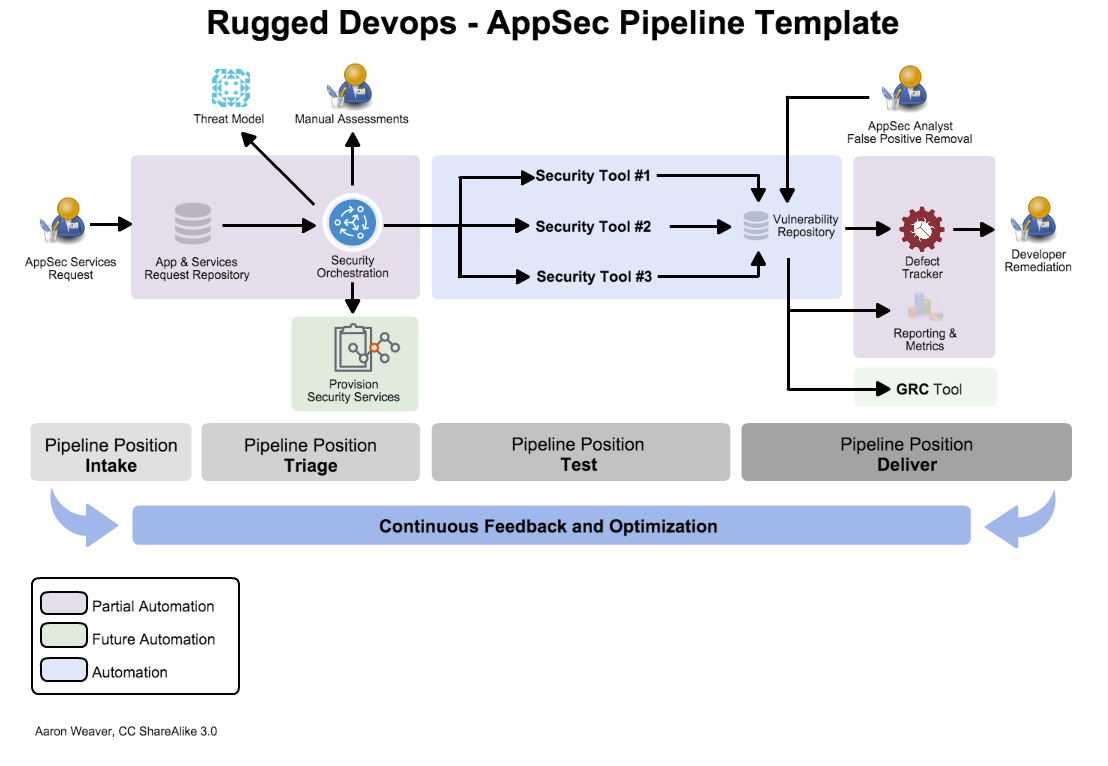
Over the years, industry conferences, whitepapers, and open-source documentation have proven the viability of automated security integration, creating a strong consensus for its adoption. In October 2015, OWASP published a breakthrough reference blueprint for an Application Security (AppSec) Pipeline.
This reference template satisfies all the requirements of a modern AppSec pipeline: it is built for iterative improvement and designed to scale organically over time.
The primary objective of an AppSec Pipeline is to provide a consistent, streamlined workflow between the Application Security team and its core stakeholders—including developers, QA engineers, product managers, and business executives. Throughout the lifecycle, every security activity has well-defined states. To optimize critical human resources and eliminate friction, the pipeline relies heavily on automation for repetitive tasks.
Global Architecture & Pipeline Stages
The AppSec pipeline is structured into four distinct, sequential zones:
[ Intake ] ──> [ Triage ] ──> [ Test ] ──> [ Deliver ]
   │                                            ▲
   └────────── Continuous Feedback ─────────────┘
1. Pipeline Position: Intake
This is the entry point where internal stakeholders request AppSec services (such as dynamic, static, or manual security assessments) from the cybersecurity team. The intake process utilizes an App & Services Request Repository, where requesters select from a standardized menu of services or provide bespoke technical details when necessary.
2. Pipeline Position: Triage
During this phase, the security team determines the scope, context, and applicability of the requested services. This stage defines which automated workflows, scans, and policies apply to the application profile.
3. Pipeline Position: Test
This is the heart of the pipeline. Here, various AppSec tools are fully automated and executed in parallel. The raw findings are aggregated into a central Vulnerability Repository, where they undergo automated and manual analysis by an AppSec Analyst to filter out false positives.
4. Pipeline Position: Deliver
The final stage focuses on routing actionable data back to the engineering teams. For this Proof of Concept (PoC), findings are automatically fed into a Defect Tracker (Jira) as actionable tickets, while high-level summaries and metrics are exported to a GRC (Governance, Risk, and Compliance) tool for executive reporting.
PoC Focus Areas
The scope of this Proof of Concept specifically focused on implementing and integrating two critical elements of the pipeline: Application Vulnerability Correlators (AVC) (represented by the Security Orchestration and Vulnerability Repository layers) and Threat Modeling.
1. The Value Proposition of Application Vulnerability Correlators (AVC)
Application Vulnerability Correlation solutions help development and security teams prioritize remediation efforts effectively. By nature, SAST and DAST scanners generate false positives and fragmented data, creating severe bottlenecks in DevOps velocity.
AVC solutions solve this scalability issue through two core capabilities:
-
Deduplication: By grouping identical findings across multiple scanning tools, AVC reduces noise and lowers the rate of false positives.
-
Correlation: By matching a theoretical code vulnerability (SAST) with an active, exploitable finding in the running application (DAST), the AVC proves that a vulnerability is real, allowing teams to prioritize these high-confidence defects.
2. The Strategic Role of Threat Modeling
Threat modeling shifts security left by introducing a proactive, risk-based approach at the design phase. It serves as an early-stage risk assessment that accompanies engineering blueprints with concrete technical countermeasures. Just like the automated testing phases, the threat modeling process integrates directly into the developer workflow by translating identified risks into actionable tasks within Jira.
Project Leadership & Key Contributions
As the Lead Project Manager / DevSecOps Delivery Lead, I managed this initiative end-to-end, steering the project from its initial conception to successful delivery. My role encompassed technical leadership, team management, and stakeholder alignment:
-
End-to-End Project & Team Management: Led a cross-functional technical team, defining project milestones, allocating resources, and ensuring the delivery of the PoC within scope and timeline.
-
DevOps Integration & Deployment Support: Provided hands-on guidance during the deployment of the various security services, ensuring their seamless integration into the existing CI/CD DevOps pipeline.
-
Product & Commercial Management: Handled vendor relationships and product management, aligning technical capabilities with business goals and navigating commercial/licensing requirements for the solutions evaluated.
-
Change Management & Feedback Loops: Promoted a culture of continuous improvement by conducting comprehensive post-mortem reviews, gathering feedback, and delivering the final Retrospective to executive leadership to guide future enterprise-wide rollouts.
Portfolio Metadata
-
Role: End-to-End Project Manager / DevSecOps Lead
-
Frameworks Referenced: OWASP AppSec Pipeline, Rugged DevOps
-
Core Core Focus: Security Orchestration, AVC (Deduplication/Correlation), Jira Integration, Threat Modeling, Team Leadership.